|
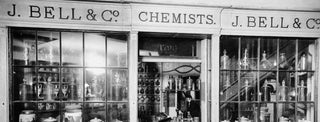
John Bell & Croyden was formed in 1908, being the amalgamation of the well known business of John Bell & Co of 338 Oxford Street and that of Charles Croyden & Co, of 55 Wigmore Street. The business of John Bell & Co in Oxford Street goes back to 1798 and belongs to the history of Pharmacy. When John Bell opened his Pharmacy the area was so thinly populated that the business was thought to be “a very poor prospect”. In order to create the impression of a brisk business a boy was employed to sit in the window and pound away at an empty mortar. John’s two sons Jacob and Frederick joined the business and Jacob became sole proprietor on the death of his father in 1849. The business was the subject of a painting by W. Hunt in 1842 called “The Shop Boy” which was engraved by J.G.Murray and for many years widely distributed. Jacob Bell was a considerable patron of the arts with friends such as artists of the day, Frith, Landseer and Etty and also authors such as Dickens and Thackeray. On his death he bequeathed his valuable collection of paintings to the nation, and they are still held in the National Gallery and Tate Britain. Jacob Bell was the founder and the moving force behind the Pharmaceutical Society, (now The Royal Pharmaceutical Society of Great Britain). Thirteen of the founder members of the Society had been at one time or another employed at John Bell and Co. In 1841, Jacob started (as proprietor and editor) a journal, which in 1842 took the title “The Pharmaceutical Journal”. It was one of the few technical periodicals of the time. On June 1st 1859 (only 18 days before his death) Jacob stated it was his intention to present the copyright to the Society. The deed of transfer was signed by Jacob on his death bed a few hours before he died, at the age of 49. With no heirs the business passed to Jacob’s partner Thomas Hyde Hills and then to his son Walter Hills under whose management the business developed both as a retailer and wholesaler. In 1908, the operations became two separate companies and the retail business merged with Charles Croyden and Co of Wigmore Street under the dynamic management of John D. Marshall. In 1912 the business moved to its current location at 50 Wigmore Street and was opened by the Lord Mayor of London. John Bell & Croyden continued to develop through the 20th Century to become the unique business it is today. The store is situated on the corner of Welbeck Street and Wigmore Street, close to Harley Street, the medical centre of excellence in the UK. John Bell & Croyden has the privilege of holding the Royal Warrant as Pharmacists to Her Majesty The Queen. We are very proud of our history and equally proud of our own vision for the future - we are determined to continue this fine tradition whilst taking John Bell & Croyden into the 21st century and beyond. Please read on for an extended in depth version of our History. John Bell's family has been traced back to the middle of the seventeenth century. A John Bell married Elizabeth at Embleton near Cockermouth, Cumbria on April 2 1651. In the early eighteenth century, three of their grandchildren moved to London. One of these grandchildren, also called John, had a son called Jacob. This Jacob was the paternal grandfather of the Jacob Bell who is the subject of this exhibition.
|
|
According to Jacob junior, his grandfather had been a successful mastmaker at Wapping Wall in London's Docklands until the American War of Independence. He then became a hosier to avoid any involvement with the supply of materials for war, which was against his principles as a Quaker. However, on the senior Jacob's marriage certificate to Sarah Sheppard in September 1771, he was described as a 'hozier and citizen and Longbow Stringmaker.' On its fifth daughter’s birth certificate in 1785, he was described as a mastmaker. It therefore seems that he did profit from the prosperous shipbuilding industry that the American War brought about. In 1798, aged only 23 and within a year of completing his apprenticeship, John opened his own business as a chemist and druggist at 338 Oxford Street. He had financial support from his father and his younger brother Jacob worked as his apprentice. Sadly, Jacob died of consumption in October 1805, aged only 22. However the shop was an immediate success. John took only two years to pay off the capital he had borrowed from his family, and he had soon taken on three apprentices, all from Quaker families. He seems to have run a very tight ship with strict roles and responsibilities for all involved in the business. Rather than joining the Society of Apothecaries, he actively stood against them. In 1813, he became a member of the committee that secured exemption for chemists and druggists from control by the apothecaries under the 1815 Apothecaries Act. John went on to second the motion to establish the Pharmaceutical Society in 1841. He died in 1849. Jacob Bell was born in 1810, the fourth child of John and Eliza Bell. Aged 12, Jacob was sent to his uncle's school near Darlington, for about four years. The school had a good reputation with Quakers, and Jacob followed his family's religious persuasion by writing two essays against war, and against slavery. However, as an adult, Jacob abandoned Quakerism. One incident recounted by WP Frith sees Jacob dressed up as a woman so that he could break the Quaker custom of separating men and women on opposite sides of the room during a meeting. Bell left the meeting when two members spotted him. Ultimately he was disowned by the Kingston Monthly Meeting in 1855 for absenteeism. The paradox between the father's faith and the son's lifestyle has been pointed out by SWF Holloway: it was John Bell's financial success that provided the means for Jacob to develop interests and abilities which 'lured him out of the confines of the meeting-house and dispensary into the temptations offered by politics and the arts.' In 1827, on leaving school, Jacob was apprenticed in his father's business. He had to observe all of the same rules and regulations as the other apprentices. However, he eventually gained a little more freedom to attend lectures on chemistry at the Royal Institution, and on physic (medicine) at King's College. When he moved into a larger bedroom, he converted it into a laboratory that included a furnace. He made life-long friends with his colleagues at John Bell and Co, including Henry Deane and Theophilus Redwood.
|
|
When Jacob returned from a European trip with E Landseer in 1840, he was supposed to be resting to improve his health. He had suffered from a 6 week bout of quinsy (peritonsillar abscess) while they had been in Geneva. However, he threw himself into the establishment and development of the Pharmaceutical Society. His condition (laryngeal phthisis) continued and his health declined through the 1840s and 1850s, no doubt hastened by his hard work. By the end of his life he was unable to speak, and hardly able to eat which meant that he became emaciated. He continued to write and take part in meetings and didn’t take to his bed. He died on 12 June 1859, and was interred at Tunbridge Wells cemetery in a plot that he had selected. John Bell enlarged his Oxford Street pharmacy in 1806, and in 1819 took on two of his former apprentices, Thomas Zachary and John H Walduck, as partners. The business became John Bell and Co. Zachary took over management of the shop and Bell went to live at the Clock House, West Hill, Wandsworth – at that time a country estate. The business benefited greatly from the rise of the medical area centred on Harley Street and the development of Regent Street. Every preparation that the shop sold was made on the premises. The business had a thriving stream of apprentices and short-term pupils, and was responsible for starting many well-known pharmacists in their careers. The business continued to thrive after John Bell’s death in 1849. In 1908, John Bell and Co merged with Croyden and Co, which had been established by one of John Bell’s former assistants, Charles Croyden, in 1832. The combined business moved to its present location at 50-54 Wigmore Street in 1912. It was acquired by Savory & Moore in 1928, subsequently becoming part of the Lloyds Chemists (now Lloyds Pharmacy) chain. Jacob Bell became sole proprietor of the family business in 1849. Amazingly, considering all of his other pursuits, he seems to have personally supervised the shop. The man in charge on a daily basis was Thomas Hyde Hills. The shop was open seven days a week from 8am to 11pm. However, all staff including apprentices had time for recreation, religious observance and study. Staff were also encouraged to attend lectures at the Pharmaceutical Society's School of Pharmacy. Bell was particularly strict about the accuracy of prescriptions, unadulterated materials, and following standards such as the London Pharmacopoeia. Jacob Bell was central to the development and running of the Pharmaceutical Society for the rest of his life. He was the first editor of The Pharmaceutical Journal. In addition, in 1850, he was elected as MP for St Albans in order to represent the interests of pharmacy within the government. For more information please click on the link provided by The Museum of The Royal Pharmaceutical Society of Great Britain. |